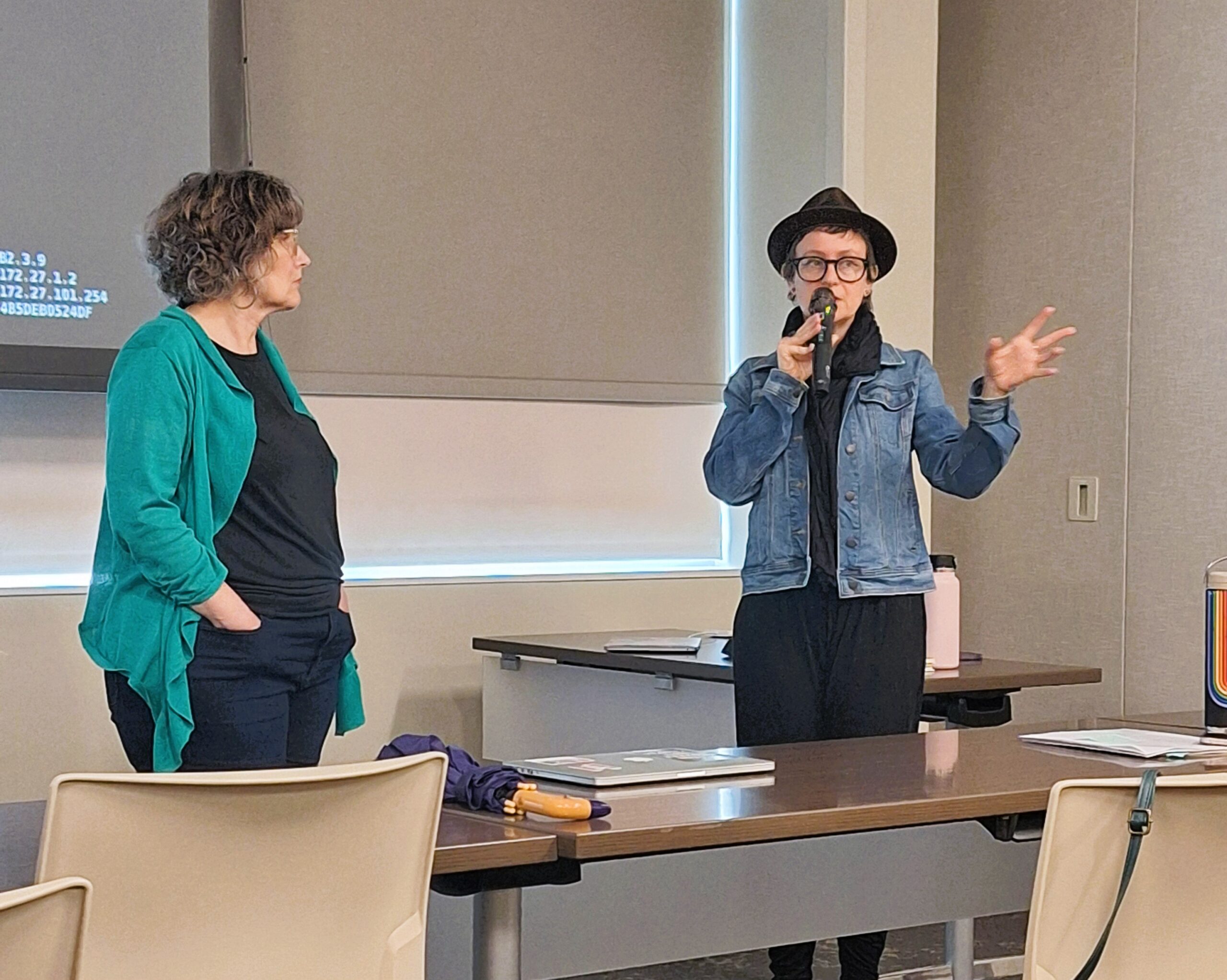
In celebration of National Poetry Month, the Columbia Chapter of the Missouri Writers Guild welcomed two accomplished poets, Lynne Jensen Lampe and Cass Donish, for a thoughtful and generative presentation on intertextual writing during our April 12 meeting.
“Intertextual?”
Intertextual writing, at its core, is the practice of engaging with other texts — whether literary works, historical documents, or visual art — to inspire, shape, or directly inform new creative work. It invites writers into conversation with existing material, opening up space for reinterpretation, expansion, and discovery.
Research as a Creative Practice
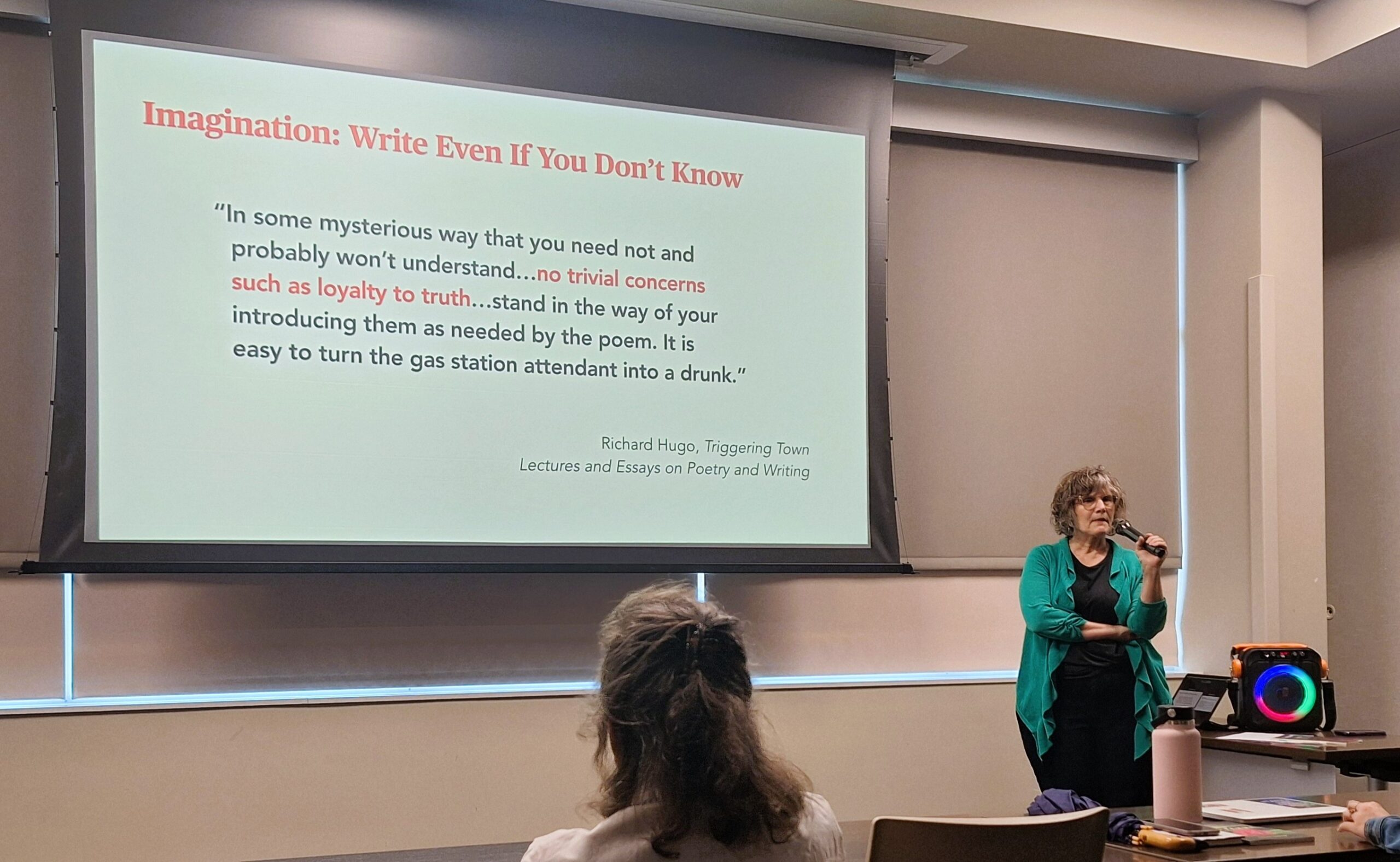
Lynne Jensen Lampe’s portion of the presentation emphasized the role of research in poetry, an approach that challenges the idea that poems must emerge solely from lived experience. While writers are often told to “write what you know,” Lynne encouraged us to also write what we don’t know and to use research as a tool for imaginative expansion.
As she put it:
“We have to remain open until the poem is done because if not, we’ll miss opportunities to make it better, to enrich it, to tell the story we want to tell.”
By remaining open and curious, poets can move beyond expectations of what a piece “should” be and instead create work that stretches, or even redefines, the boundaries of genre.
One particularly compelling element of Lynne’s presentation was her breakdown of why research matters in poetry.
Research can:
- Confirm memory
- Add depth and nuance
- Suggest metaphor
- Inspire curiosity and thus a poem
- Generate new work through visual art (ekphrasis) or literature
- Provide historical or cultural context that shapes tone and diction
- Support world-building
- Reveal unexpected connections
- Even influence form, such as using official documents (like court records) as a structural or visual guide
She reinforced this idea with a powerful quote from Hai-Dang Phan:
“…researching and writing are complementary, mutually affecting acts. [The] poet-researcher is a scout, a rover, and a trespasser… poems and essays continually enact that anticipatory moment before discovery, of making connections, before anything is ever fixed into ideas.”
Hai-Dang Phan
Lynne also shared examples of found poems, erasures, and blackout poetry, including selections from her own work, demonstrating how research and source material can be transformed into something entirely new.
Writing in Conversation with Other Texts
Cass Donish’s presentation explored intertextuality through deeply personal and lyrical examples from their own work. They read selections from “Your Dazzling Death,” a collection shaped by grief following the loss of their partner, Kelly. Pieces such as “Grief Story,” “Dignity,” “A Year,” and “How I Became Possible” illustrated the emotional depth and resonance that their poetry carries.
Cass also introduced the concept of the palimpsest, a form of writing created by layering new text over an existing source, allowing traces of the original to remain visible. In contrast to erasure, which removes or obscures, palimpsest writing builds upon and transforms the original material.
Their poem “Kelly in Violet” drew from “The History of Violets” by Marosa di Giorgio (translated by Jeannine Marie Pitas). As Cass explained: “di Giorgio and Pitas helped me access this telling.”
Through this process, borrowed language takes on entirely new meaning within the poet’s work, demonstrating how intertextual writing can reshape and recontextualize source material.
One of the most resonant takeaways from Cass’s talk was their perspective on working with source texts:
“We just have our one mind. It can be really powerful to have a companion text to work with. Really, I think of it as a friendship… It’s a powerful thing to make friends with other text.”
Continuing the Conversation
We are grateful to Lynne Jensen Lampe and Cass Donish for sharing their time, insight, and creative practices with our chapter. Their presentations offered not only practical strategies, but also an invitation to read more deeply, to research more boldly, and to write in conversation with the world around us.
We encourage you to explore their work and learn more through the links below.
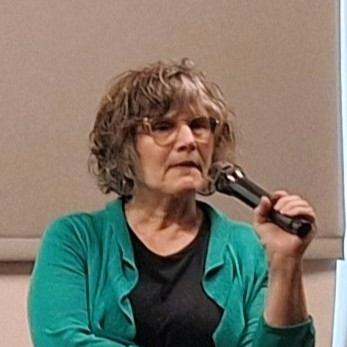
Lynne Jensen Lampe’s poetry appears widely in journals such as “The Kenyon Review,” “Okay Donkey,” “Stone Circle Review,” and “Small Orange,” as well as “Well Versed” and other anthologies in the U.S., U.K., and Germany. Her debut collection, “Talk Smack to a Hurricane,” explores themes of mothers, daughters, and mental illness. She lives in Columbia, Missouri, where she edits academic writing, reads for “Tinderbox Poetry Journal,” and is a founding member of Dame Good Writers.
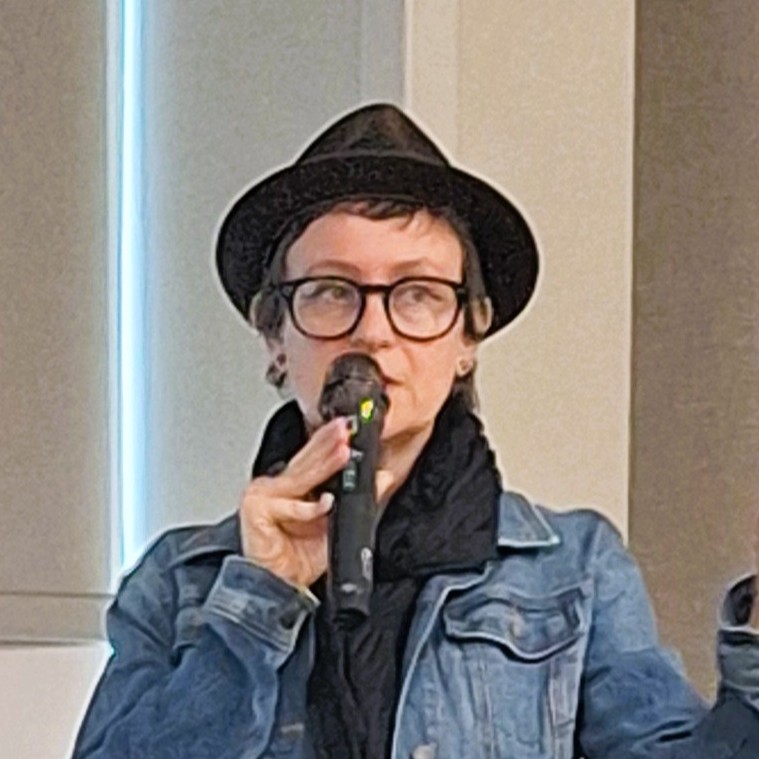
Cass Donish is a queer poet, writer, and educator from the Greater Los Angeles area. Their work is shaped by investments in gender, grief, and place. They are the author of the award-winning collections “Your Dazzling Death,” “The Year of the Femme,” and “Beautyberry.” They hold an MA in Cultural Geography from the University of Oregon, an MFA in Poetry from Washington University, and a PhD in English from the University of Missouri, where they are currently a writer-in-residence. They are also a co-founder of Nightjar Arts Collective.
Article and photos by:

Bethany Spitzmiller
Bethany Spitzmiller is an editor, writing coach, and communication professional based in Columbia, Missouri. She holds a bachelor’s degree in English and communication with an emphasis in Journalism from Truman State University and a master’s degree in communication from the University of Central Missouri.
Her editorial experience spans newspapers, magazines, and digital media, as well as ghostwriting for a marketing agency. Her work has appeared in high-tier publications such as Entrepreneur, Forbes, and Inc. She is also the founder of Spitzfire Editorial, where she provides freelance editing and writing coaching services.