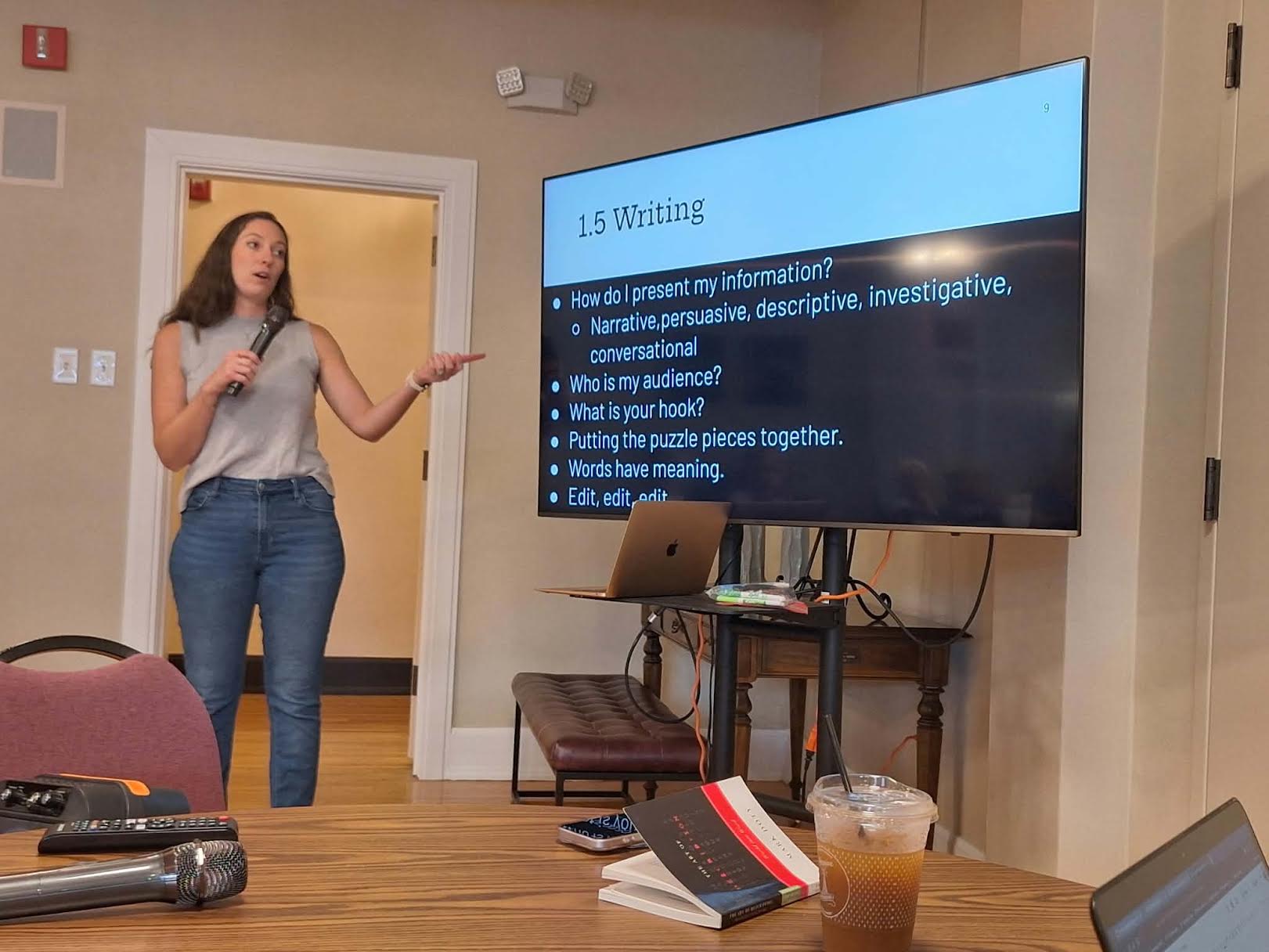
What makes a story worth telling? And how can writers move beyond the information already available to uncover something meaningful? These were just a few of the questions explored with Jordan Durham for her presentation, “Bearing Witness,” on feature writing and creative nonfiction.
Does a Story Matter?
Durham began with discussing the foundation of any compelling piece: an idea. But an idea
alone isn’t enough. Writers must also ask, “Who cares?” Identifying why a story matters, and to
whom, helps writers find its purpose and determine how to approach it.
From there, the work begins.
Putting it Together
Research can take many forms, from online searches and library resources to physical media and interviews. Durham emphasized the importance of remaining adaptable throughout the process. A story may change as new information emerges, and writers must be willing to follow unexpected discoveries rather than force their original assumptions onto the narrative.
One example of memorable feature writing that demonstrates flexibility is Gay Talese’s “Frank
Sinatra Has a Cold,” published in Esquire in 1966. Unable to secure a direct interview with
Sinatra, Talese built his profile through observation and conversations with the people
surrounding the singer. The resulting piece became a celebrated example of literary journalism,
demonstrating how a writer can create a vivid portrait of a subject even when the most obvious
route to the story is unavailable.
Going to the Source

The presentation also explored the art of interviewing. Before an interview, writers should figure out what information is already available online and consider what they can ask to go beyond it.
Knowing the purpose of the interview helps shape better questions, while open-ended prompts encourage interviewees to share more than rehearsed answers.
And sometimes, the most effective interviewing technique is to stop talking.
“Silence is your best friend,” Durham explained, noting that people often fill a pause with additional thoughts or details. Rather than rushing to the next question, writers can give their subjects room to reflect and elaborate. To close an interview, she recommended asking a simple but revealing question: What would you like readers to know?
That final question captures the spirit of “Bearing Witness.” Whether writing a magazine feature
or a piece of creative nonfiction, the goal is to look closely, listen carefully, and remain open to
what a story has to reveal. By pairing thoughtful research with genuine curiosity, writers can
move beyond the surface and bring their subjects, and their stories, to life.
Bringing it to the World
Durham also discussed the practical side of getting work published. Writers should study the
publication they’re pitching, understand its submission guidelines, and tailor their proposals
accordingly. Even a well-crafted pitch may go unanswered, she reminded attendees, and that’s
okay. Rejection and silence are part of the process, not a reflection of a story’s worth.
Continuing the Conversation
We are grateful to Jordan Durham for sharing her time and creative practices with our chapter. We encourage you to explore her work and learn more through the link below.

Jordan Durham is an editor and writer with more than a decade of experience in journalism, client content, and publishing. Her work has appeared in publications including Forbes and Entrepreneur, as well as local magazines. She has collaborated with publishers across fiction, nonfiction, and poetry and currently serves as editor of Columbia City Lifestyle magazine.
Article & photos by Bethany Spitzmiller

Bethany Spitzmiller
Bethany Spitzmiller is an editor, writing coach, and communication professional based in Columbia, Missouri. She holds a bachelor’s degree in English and communication with an emphasis in Journalism from Truman State University and a master’s degree in communication from the University of Central Missouri.
Her editorial experience spans newspapers, magazines, and digital media, as well as ghostwriting for a marketing agency. Her work has appeared in high-tier publications such as Entrepreneur, Forbes, and Inc. She is also the founder of Spitzfire Editorial, where she provides freelance editing and writing coaching services.